 CoreNutriGuide
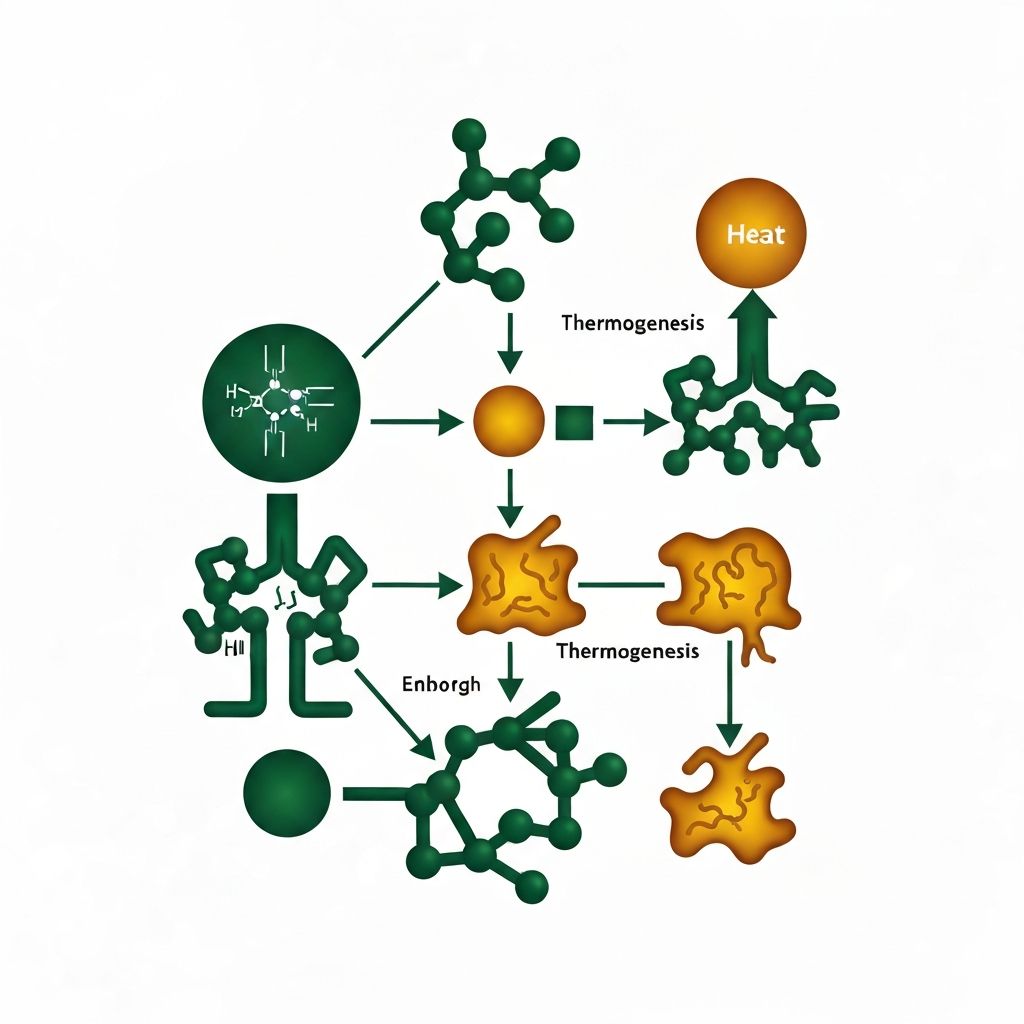
Introduction to Thermogenesis
Thermogenesis refers to the production of heat in the body. While the body's primary purpose in energy expenditure is to enable work and maintain basic physiological function, a substantial portion of energy is released as heat. This heat production is not merely a byproduct of metabolism but involves active physiological processes that can be regulated and adapted. Understanding the mechanisms and factors influencing thermogenesis provides insight into individual variation in energy expenditure.
Diet-Induced Thermogenesis (DIT)
Diet-induced thermogenesis, also called the thermic effect of food (TEF) or postprandial thermogenesis, refers to the increase in energy expenditure that occurs following nutrient intake. This increase results from the metabolic processes required to digest, absorb, and process nutrients. DIT is obligatory—it occurs with all food intake—though the magnitude varies substantially with nutrient composition.
Protein Thermogenesis: Protein produces the greatest thermic effect, requiring approximately 20-30% of its energy content for digestion and processing. This means that 100 calories of protein requires 20-30 calories of energy to process, with the remaining 70-80 calories available for other uses. This large thermic effect results from the metabolic demands of amino acid absorption, transport, and incorporation into proteins.
Carbohydrate Thermogenesis: Carbohydrates produce a moderate thermic effect of approximately 5-10%. The variation depends on carbohydrate type and individual factors including insulin sensitivity and physical fitness. Complex carbohydrates may produce slightly greater thermic effects than simple sugars due to greater metabolic processing.
Fat Thermogenesis: Fats produce the smallest thermic effect, requiring only 0-3% of their energy content for digestion and processing. This minimal thermogenesis reflects the relatively efficient metabolic pathways for fat absorption and storage.
The proportions of macronutrients in the diet thus influence total DIT. A high-protein diet produces greater thermogenesis than a high-carbohydrate or high-fat diet at equivalent energy intake. However, it is important to note that DIT typically accounts for only 10% of total daily energy expenditure, meaning that macronutrient composition differences in DIT produce relatively modest effects on total daily expenditure.
Adaptive Thermogenesis
Adaptive thermogenesis refers to regulated changes in heat production that occur in response to environmental or physiological challenges. This differs from DIT, which is a fairly fixed response to nutrient intake. Adaptive thermogenesis represents the body's ability to adjust metabolic rate in response to sustained changes in energy availability.
Cold-Induced Thermogenesis
Exposure to cold increases metabolic rate and heat production through multiple mechanisms. Shivering thermogenesis involves muscle contractions that produce heat as a byproduct of muscle work. Non-shivering thermogenesis involves increased metabolic heat production without visible muscle contractions, mediated primarily by brown adipose tissue (brown fat) and the protein UCP1 (uncoupling protein 1).
Brown fat is metabolically active tissue distinct from white fat. It contains numerous mitochondria with UCP1, a protein that allows the mitochondrial proton gradient to dissipate as heat rather than being used for ATP production. This uncoupling of oxidative phosphorylation enables heat production without ATP synthesis. The significance of brown fat for energy expenditure in adults remains incompletely understood, though recent research suggests that brown fat activity may contribute meaningfully to total expenditure in some individuals.
Metabolic Adaptation to Energy Deficit
Sustained energy deficit triggers compensatory decreases in metabolic rate through adaptive thermogenesis. This metabolic adaptation represents an energy conservation response that develops progressively during prolonged restriction. Multiple mechanisms contribute:
Reduced Sympathetic Activity: The sympathetic nervous system, which increases metabolic rate, shows reduced activity during caloric restriction. This reduction occurs in response to the decreased leptin signaling accompanying energy deficit.
Thyroid Hormone Reduction: Circulating thyroid hormones decrease during sustained restriction. T3 (triiodothyronine), the active form of thyroid hormone, may decline more substantially than TSH (thyroid-stimulating hormone), reducing metabolic rate below that expected from body weight alone.
Reduced Activity Thermogenesis: Individuals under caloric restriction often show reduced spontaneous activity levels (NEAT), providing an additional mechanism for reducing energy expenditure.
The magnitude of metabolic adaptation to caloric restriction varies substantially among individuals. Some individuals show minimal metabolic decline despite significant energy deficit, while others show pronounced reductions in metabolic rate. Genetic factors, prior dietary history, physical fitness, and the degree and duration of restriction all influence the magnitude of adaptation.
Metabolic Adaptation to Energy Surplus
Sustained energy surplus can also trigger adaptive thermogenesis in the form of increased metabolic rate. However, this adaptive increase to surplus is generally smaller in magnitude than the adaptive decrease to deficit. The asymmetry reflects evolutionary pressures where reducing expenditure during scarcity was more critical for survival than increasing expenditure during abundance.
Increased sympathetic activity and thyroid hormone elevation accompany surplus, promoting increased metabolic rate. However, these increases often fail to fully compensate for the energy surplus, contributing to weight gain in sustained surplus conditions.
Activity Thermogenesis and NEAT
Non-exercise activity thermogenesis (NEAT) refers to energy expenditure from daily activities—walking, occupational work, fidgeting, and maintaining posture. NEAT varies substantially among individuals and can account for 15-30% of daily expenditure. Importantly, NEAT is not fixed but can increase or decrease with environmental demands and behavioral patterns.
Studies examining energy balance show that some individuals maintain stable weight by spontaneously adjusting NEAT in response to changes in energy intake or exercise. Others show minimal NEAT adjustment, instead accumulating the energy surplus as weight gain. This variation in NEAT compensation appears partly behavioral and partly physiological, with implications for understanding individual variation in weight stability.
Individual Variation in Thermogenesis
Substantial individual variation exists in all components of thermogenesis. At equivalent body weights, individuals differ in basal metabolic rate (reflecting differences in brown fat, mitochondrial density, and other factors). They differ in DIT responses to identical meals. They differ in their capacity for metabolic adaptation to restriction. Genetic factors account for some of this variation, with heritability estimates for metabolic rate around 30-40%. Environmental factors including physical fitness, prior dietary history, and lifestyle patterns also substantially influence thermogenic capacity.
Implications for Understanding Energy Expenditure
Thermogenesis illustrates that energy expenditure is not a fixed value but a dynamic process with multiple regulated components. The body actively adjusts heat production in response to nutrient intake, environmental challenges, and sustained changes in energy availability. However, these adjustments are partial—they do not completely prevent weight change in response to sustained energy imbalance, but they do resist such change to varying degrees depending on individual physiology and the magnitude of imbalance.
Conclusion
Thermogenesis encompasses multiple pathways through which the body produces heat and expends energy. Diet-induced thermogenesis varies with macronutrient composition but contributes modestly to total expenditure. Adaptive thermogenesis enables the body to adjust metabolic rate in response to environmental and physiological challenges, though these adaptations are incomplete and show substantial individual variation. Understanding these mechanisms provides essential context for comprehending individual differences in metabolic rate and energy requirements.